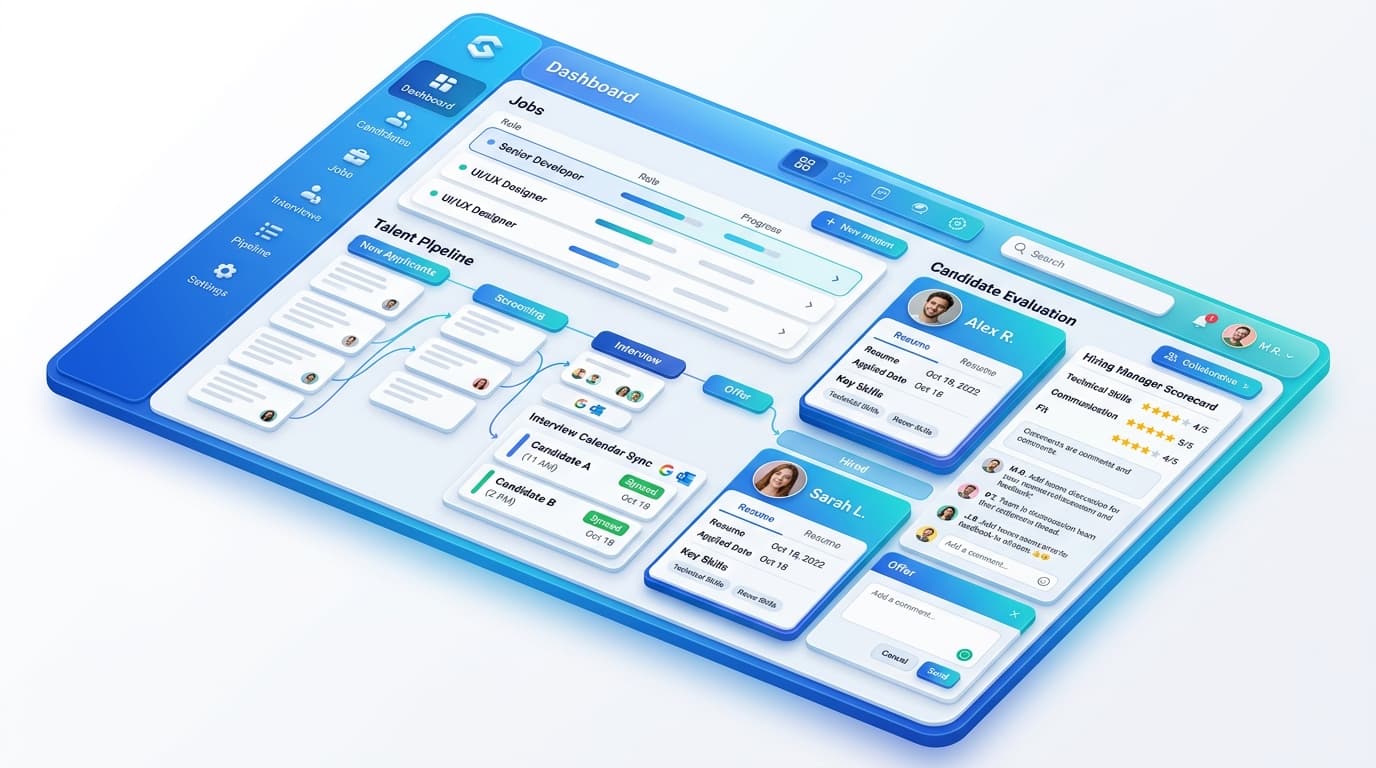
A recruitment pipeline has 7 stages: sourcing, applied, screening, interview, final interview/assessment, offer, and hired. Track how many candidates move from each stage to the next (the conversion rate) and how long they wait there. The stage with the lowest conversion or the longest wait is your bottleneck.
- Keep stages few and consistent across roles (7 is plenty) so reports compare like with like.
- Measure conversion rate and days in stage for every stage.
- The most common bottlenecks are slow screening, interview scheduling and late feedback, all fixable with process and automation.
What are the 7 stages of a recruitment pipeline?
| # | Stage | What happens | Key metric |
|---|---|---|---|
| 1 | Sourcing | Job posted to channels; passive candidates contacted; referrals requested | Applicants per job, by source |
| 2 | Applied | Candidate submits application; CV parsed into a profile | Application completion rate |
| 3 | Screening | Recruiter reviews fit, knock-outs, phone screen | Applied → screened-in % |
| 4 | Interview | First-round interview(s) with scorecards | Screened → interviewed % |
| 5 | Final interview / assessment | Hiring manager, panel, test or case | Interview → final % |
| 6 | Offer | Approval, offer letter, negotiation | Offer acceptance rate |
| 7 | Hired | Accepted, joined (after notice period in India) | Offer → joined % |
Optional stages: Talent pool (before 1), Pre-boarding (between 6 and 7), and Rejected / Withdrawn (exit states, not stages).
How do you calculate stage conversion rates?
``` Stage conversion (%) = Candidates who moved to the next stage ÷ Candidates who entered this stage × 100 ```
Example pipeline for one Sales Executive role
| Stage | Candidates | Conversion to next | Avg. days in stage |
|---|---|---|---|
| Applied | 400 | 15% → screened in | 6 |
| Screening | 60 | 33% → interview | 4 |
| Interview | 20 | 30% → final | 7 |
| Final | 6 | 50% → offer | 3 |
| Offer | 3 | 67% → accepted | 4 |
| Hired | 2 | — | — |
In this example, applicants wait 6 days before anyone screens them, and interviews take 7 days to schedule and complete. Those are the bottlenecks. Illustrative data.
What are the common pipeline bottlenecks, and how do you fix them?
| Bottleneck | Symptom | Fix |
|---|---|---|
| Too many irrelevant applicants | Low applied → screened % | Sharper job titles, salary range, 3–5 knock-out questions (job description guide) |
| Slow screening | High days in "Applied" | Resume parsing + match score to sort; 48-hour screening SLA |
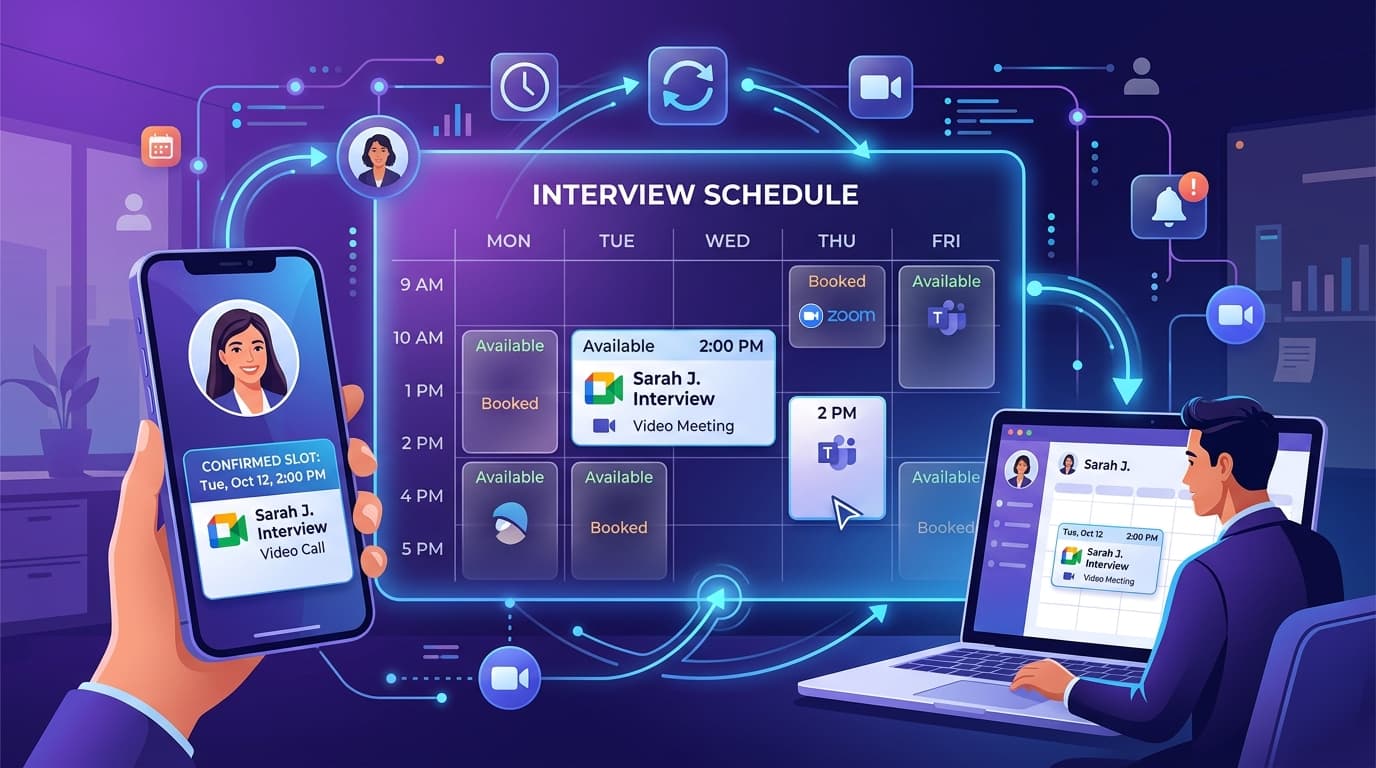
| Interview scheduling ping-pong | High days in "Interview" | Self-scheduling links + calendar sync (scheduling guide) |
| No-shows | Interviews booked but not held | WhatsApp reminders 24h + 2h before (templates) |
| Late interviewer feedback | Candidates stuck after interviews | Scorecard due within 2 hours; reminders (feedback guide) |
| Slow offer approval | High days in "Offer" | Pre-approved bands (hiring approval process) |
| Offer declines / joining dropouts | Low offer → joined % | Competitive CTC, keep in touch during notice, backup candidate |
How many candidates do you need in the pipeline?
Work backwards from your conversion rates. With the example above (≈0.5% applied → hired), you need about 200 applicants per hire. Improve screening relevance to 25% and you'd need about 120. Track this per role family, because sales, tech and frontline roles behave very differently.
How should you set up pipeline stages in an ATS?
- 1Use the same core stages for every job, and add role-specific steps (e.g., "Assignment") only where needed.
- 2Make each stage an action, not a status ("Phone screen", not "Pending").
- 3Require a reason for rejection or withdrawal; you'll learn why candidates drop out.
- 4Automate what you can: emails on stage change, reminders, scorecard requests.
In OneATS, the [hiring pipeline](/features/hiring-pipeline) is a visual board with your own stages, bulk actions and automatic candidate updates, and [analytics](/features/analytics) shows conversion and days-in-stage for every job.
Which metrics should you report every month?
- Applicants per job, by source → source of hire
- Conversion rate per stage
- Average days in stage
- Time to hire and time to fill → formulas
- Offer acceptance rate
- Cost per hire → formula
Frequently asked questions
What are the stages of a recruitment pipeline? Sourcing, applied, screening, interview, final interview or assessment, offer, and hired. Talent pool and pre-boarding are optional extra stages.
What is the difference between a recruitment pipeline and a recruitment funnel? They describe the same flow. "Funnel" emphasises how candidate numbers shrink at each stage; "pipeline" emphasises the movement and timing between stages.
How do I find bottlenecks in my hiring process? Look for the stage with the lowest conversion rate or the most days in stage, then fix the cause: relevance, scheduling, feedback or approvals.
How many stages should a hiring pipeline have? Around 5–8 core stages works for most companies. More stages make reporting and candidate updates harder.
--- See the OneATS hiring pipeline · Structured interview process
Editorial Integrity & Sourcing: All articles are authored and verified by our recruitment operations and engineering team. Product details verified against the OneATS product in November 2026. Job-board connections work as described on each integration page.

Pankaj Mukadam is the Head of Product at OneATS. With deep expertise in talent acquisition infrastructure and recruitment operations, he leads product architecture and hiring workflows at OneATS, helping companies streamline recruitment across India and globally.