Time to fill and time to hire are the two numbers every recruiting team is asked about, and the two numbers most often mixed up. Time to fill tells you how long it takes to fill a job. Time to hire tells you how quickly you move a candidate once you find them. This guide explains the difference, gives you both formulas with worked examples, shows what "good" looks like, and explains how Indian notice periods change the picture.
- Time to fill = days from job requisition approved to offer accepted.
- Time to hire = days from a candidate entering your pipeline to that candidate accepting the offer.
- Time to fill measures your whole hiring process; time to hire measures how fast you move good candidates.
- In India, track offer-to-join time separately, because 30 to 90 day notice periods can more than double the time before a new hire starts.
- An ATS records every date automatically, so both metrics are accurate without spreadsheets.
What Is Time to Fill in Recruitment?
Time to fill is the number of calendar days between opening a job and filling it. Most teams start the clock when the job requisition is approved and stop it when the selected candidate accepts the offer. SHRM uses the same definition in its recruiting benchmarks: the days from requisition opened to offer accepted, counting weekends and holidays. (SHRM 2025 Recruiting Benchmarking Report)
Time to fill is a planning metric. It tells hiring managers and finance how long a seat is likely to stay empty, and it shows whether the whole process, from approvals to sourcing to interviews, is working.
How to Calculate Time to Fill (Formula and Example)
Time to fill = Date offer accepted − Date requisition approved
Example: your requisition for a Sales Executive is approved on 1 September 2026. The selected candidate accepts the offer on 6 October 2026. Time to fill = 35 days.
To report time to fill for a team or a quarter, average it across all roles filled:
Average time to fill = Sum of time to fill for each role ÷ Number of roles filled
If three roles took 35, 42 and 28 days, your average time to fill is 105 ÷ 3 = 35 days.
Two rules keep the number honest. First, pick one start point (requisition approved or job posted) and use it every time. Second, decide whether you stop at offer accepted or at the employee's start date, and label it clearly. Mixing definitions is the most common reason time to fill reports disagree.
What Is Time to Hire?
Time to hire is the number of days between a candidate entering your pipeline and that candidate accepting your offer. The candidate "enters" when they apply, or when a recruiter sources them and adds them to the job.
Where time to fill looks at the job, time to hire looks at the candidate. It shows how fast your team screens, interviews and decides once a good person is in front of them. A long time to hire usually means slow feedback, hard-to-schedule interviews or slow offer approvals, and it is how strong candidates get lost to faster employers.
How to Calculate Time to Hire (Formula and Example)
Time to hire = Date offer accepted − Date candidate entered the pipeline
Example: using the same Sales Executive role, the hired candidate applied on 10 September 2026 and accepted the offer on 6 October 2026. Time to hire = 26 days.
For the average across hires:
Average time to hire = Sum of time to hire for each hire ÷ Number of hires
Notice that time to hire (26 days) is shorter than time to fill (35 days) for the same role. The 9-day gap is the time it took to get the job approved, posted and in front of the right candidate.
Time to Fill vs Time to Hire: Key Differences
| Time to fill | Time to hire | |
|---|---|---|
| What it measures | How long a job stays open | How fast you move a candidate |
| Clock starts | Requisition approved (or job posted) | Candidate applies or is sourced |
| Clock stops | Offer accepted | Offer accepted |
| Focus | The job and the whole process | The candidate experience |
| Mainly affected by | Approvals, sourcing, job board reach | Screening speed, interview scheduling, feedback, offer approvals |
| Used for | Headcount planning, budgets | Recruiter and hiring-manager efficiency |
| Usually | Longer | Shorter |
In short: if time to fill is high but time to hire is low, your problem is before the candidate arrives (approvals or sourcing). If both are high, your problem is inside the interview process.
What Is a Good Time to Fill and Time to Hire?
There is no single "good" number, because it depends on the role, seniority and market. As a reference point, SHRM's 2025 Recruiting Benchmarking Report put the median time to fill at about 44 calendar days for non-executive roles, counted from requisition opened to offer accepted. (SHRM 2025 Recruiting Benchmarking Report)
Use these rough guides, then set your own baseline:
- Entry-level, high-volume and campus roles: often 2 to 4 weeks to fill.
- Mid-level professional roles: around 4 to 7 weeks.
- Senior, niche technical and leadership roles: often 2 to 3 months or more.
- Time to hire: aim to keep it as short as your process allows; many teams target under 3 weeks for most roles.
The most useful benchmark is your own history. Track the median by role family for one quarter, then aim to cut it by 10 to 20 percent.
Factors Affecting Hiring Time in India
Several factors stretch hiring timelines for Indian teams:
- Slow requisition and offer approvals, especially when they run over email. See job requisition approval process.
- Posting to Naukri, LinkedIn and Indeed separately instead of at once.
- High application volumes for entry-level roles, which slow screening without resume parsing.
- Hiring managers who take days to share interview feedback.
- Interview no-shows and rescheduling, which reminders on WhatsApp can reduce. See WhatsApp interview reminders.
- Counter-offers from the candidate's current employer during the notice period.
How Indian Notice Periods Affect Recruitment Metrics
In India, notice periods of 30 to 90 days are common, and many IT and senior roles require 60 or 90 days. That means the date a candidate accepts your offer and the date they join can be months apart.
Take our example again. The candidate accepted on 6 October 2026 with a 60-day notice period, so they join on 5 December 2026. Time to fill is 35 days, but the seat stays empty for 95 days in total.
That is why Indian teams should track a third metric:
Offer-to-join time = Joining date − Date offer accepted
Keep it separate from time to fill. Otherwise your recruiting team is judged on notice periods it cannot control. Track the drop-off rate during notice periods too: candidates who accept but never join are a hidden cause of long time to fill, because the role has to be reopened.
How to Reduce Time to Fill and Time to Hire
- 1Approve faster. Use a standard requisition template and online approvals so jobs open in days, not weeks.
- 2Post everywhere at once. Publish to your careers page, Naukri, LinkedIn and Indeed in one step. See post to Naukri, LinkedIn and Indeed at once.
- 3Build a talent pool. Re-engage past applicants before you post a new job.
- 4Screen with [resume parsing](/blog/how-does-resume-parsing-work). Turn CVs into searchable profiles and shortlist in minutes.
- 5Let candidates book their own interviews. Self-scheduling removes days of back-and-forth. See interview scheduling.
- 6Set a 24-hour feedback rule. Use scorecards so interviewers submit feedback the same day.
- 7Speed up offers. Pre-approve salary bands and use an offer approval workflow.
- 8Stay in touch during notice periods. Regular check-ins reduce last-minute drop-offs.
How ATS Software Helps Track Hiring Metrics
Spreadsheets work for a few hires, but dates get missed and definitions drift as you grow.
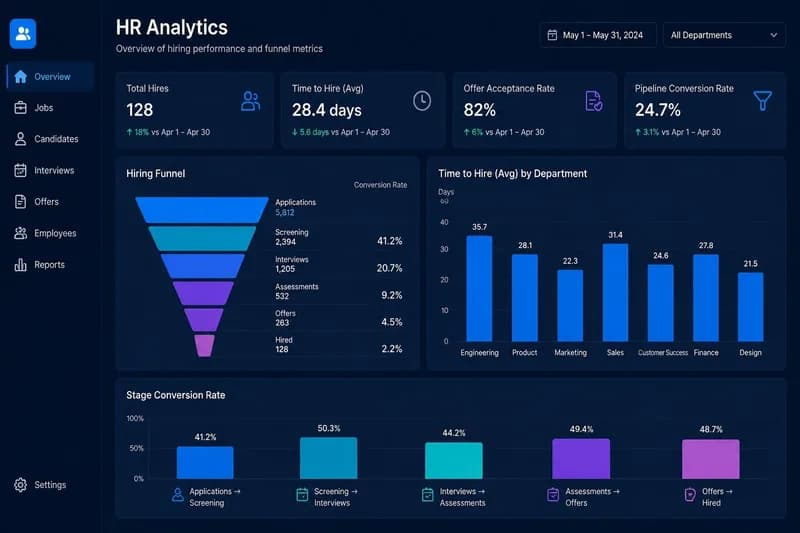
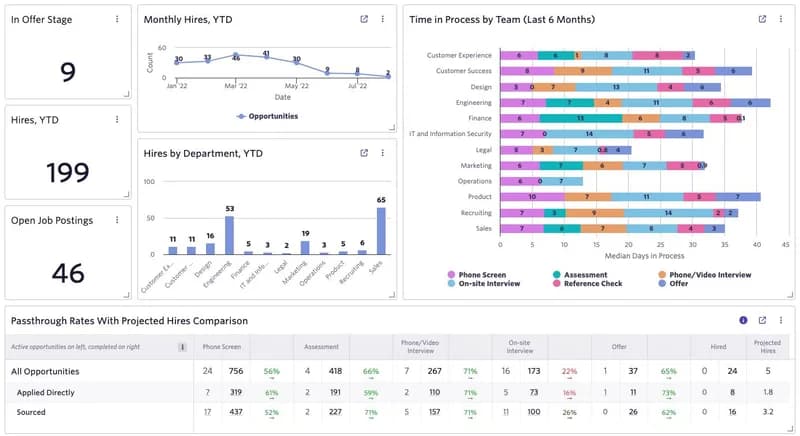
An applicant tracking system records every date automatically: when the requisition was approved, when each candidate applied, every stage change, and when the offer was accepted. That gives you accurate time to fill and time to hire for every job, team and recruiter, plus time spent in each stage, so you can see exactly where hiring slows down.
Which ATS tools offer analytics on hiring pipeline and time-to-fill? Look for an ATS that reports time to fill and time to hire automatically, shows how long candidates spend in each stage, lets you filter by job, team and source, and exports reports. OneATS reports time to fill, time to hire, funnel conversion and source of hire, shows days in stage on the hiring board, and exports reports to CSV or Excel. See ATS analytics.
Frequently Asked Questions
What is the difference between time to fill and time to hire?▼
Time to fill measures how long a job stays open, from requisition approval to offer acceptance. Time to hire measures how quickly you move a specific candidate, from the day they enter your pipeline to the day they accept your offer. Time to hire is usually shorter.
What is the formula for time to fill?▼
Time to fill = Date offer accepted − Date requisition approved. To get the average, add up the time to fill for each role and divide by the number of roles filled.
What is the formula for time to hire?▼
Time to hire = Date offer accepted − Date candidate entered the pipeline (applied or was sourced). Average it across all hires in the period.
Should time to fill end at offer acceptance or the joining date?▼
Most benchmarks, including SHRM's, end at offer acceptance. In India, track the joining date separately as offer-to-join time, because notice periods of 30 to 90 days would otherwise distort your recruiting metrics.
What is a good time to hire?▼
It depends on the role, but many teams aim to keep time to hire under three weeks for most roles. Compare against your own past medians by role family rather than a single industry figure.
Conclusion
Time to fill shows how long your jobs stay open; time to hire shows how fast you move the right people. Track both with consistent dates, add offer-to-join time if you hire in India, and review them by role every month.
Editorial Integrity & Sourcing: All articles are authored and verified by our recruitment operations and engineering team, vetted against primary regulatory documentation (such as India's DPDP Act, 2023 and EPFO/ESIC guidelines) and direct job portal APIs before publication.

Pankaj Mukadam is the Head of Product at OneATS. With deep expertise in talent acquisition infrastructure and recruitment operations, he leads product architecture and hiring workflows at OneATS, helping companies streamline recruitment across India and globally.