Cost per hire = (total internal recruiting costs + total external recruiting costs) ÷ total number of hires in the period. Internal costs are things like recruiter salaries and your ATS subscription; external costs are things like job-board fees, agency fees and referral bonuses. Measure it per quarter, per department and per source to find where money is wasted.
- Use the standard formula (based on the SHRM/ANSI standard) so numbers are comparable over time.
- Include recruiter time. It's usually the largest internal cost and the most often forgotten.
- Break cost per hire down by source. Referrals and your careers page are often far cheaper than agencies.
- Pair it with quality of hire. Cheap hires who leave in 3 months are expensive.
What is the cost per hire formula?
``` Cost per hire = (Internal costs + External costs) / Total hires ```
| Internal costs (spent inside the company) | External costs (paid to third parties) |
|---|---|
| Recruiter and HR team salaries (share of time spent hiring) | Job-board and portal fees (Naukri, LinkedIn, Indeed sponsored) |
| Hiring manager and interviewer time | Recruitment agency fees |
| ATS and recruiting software | Referral bonuses |
| Employer-branding costs (careers page, content) | Background verification |
| Onboarding admin before day one | Assessments and testing tools |
| Office space for interviews (optional) | Campus-drive travel, events |
| Candidate travel reimbursement, relocation |
How do you calculate cost per hire? A worked example (India)
A 120-person company made 24 hires last quarter.
| Item | Calculation | Cost (₹) |
|---|---|---|
| Recruiter salary (1 recruiter, 100% on hiring) | ₹60,000/month × 3 | 1,80,000 |
| HR manager time (25% on hiring) | ₹1,20,000/month × 3 × 0.25 | 90,000 |
| Interviewer time | 24 hires × 6 interviews × 1 hr × ₹800/hr | 1,15,200 |
| ATS (OneATS Growth, 2 users, annual billing) | 2 × ₹599 × 3 months | 3,594 |
| Internal total | 3,88,794 | |
| Naukri job postings + Resdex | (your invoice) | 90,000 |
| Agency fees (2 senior hires at 8.33% of ₹18 L CTC) | 2 × ₹1,50,000 | 3,00,000 |
| Referral bonuses (5 hires × ₹15,000) | 75,000 | |
| Background verification (24 × ₹1,500) | 36,000 | |
| External total | 5,01,000 | |
| Cost per hire | (3,88,794 + 5,01,000) ÷ 24 | ≈ ₹37,075 |
Illustrative numbers. Use your own invoices and salary data.
Insight from this example: two agency hires make up about a third of the total spend. Without them, cost per hire for the other 22 hires drops to roughly ₹26,800.
How do you calculate cost per hire by source?
Divide each source's external cost (plus a share of internal cost) by the hires from that source:
| Source | Hires | Source cost (₹) | Cost per hire (₹) |
|---|---|---|---|
| Referrals | 5 | 75,000 | 15,000 |
| Naukri | 9 | 90,000 | 10,000 |
| Careers page / Google for Jobs | 6 | 0 | ≈ 0 (internal cost only) |
| LinkedIn (free posts) | 2 | 0 | ≈ 0 |
| Agency | 2 | 3,00,000 | 1,50,000 |
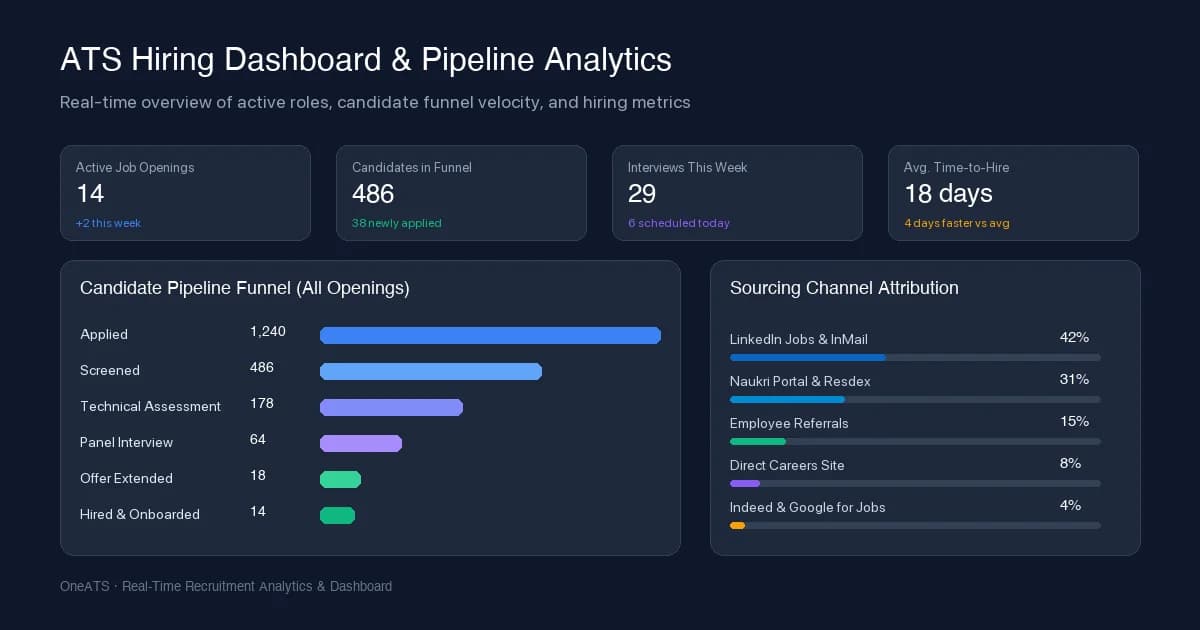
To do this you need every applicant tagged with their source. An ATS with [source tracking](/features/source-tracking) does that automatically through tracked links. See [source of hire](/blog/source-of-hire).
What is a good cost per hire?
There's no universal "good" number. It depends on role level, location and how competitive the market is. Compare against your own trend quarter over quarter, and against published benchmarks only when they come from a named, dated survey for your country and industry. Senior and niche roles will always cost more than entry-level roles, so report them separately.
8 ways to reduce cost per hire
- 1Grow referrals. A clear employee referral program with a fair bonus.
- 2Invest in your careers page and Google for Jobs. Free, compounding traffic.
- 3Re-engage your talent pool. Past silver-medallist candidates cost almost nothing to contact.
- 4Cut time-to-hire. Every extra week adds recruiter and interviewer hours. See time to fill vs time to hire.
- 5Automate scheduling and reminders. Fewer no-shows means fewer wasted interviewer hours.
- 6Use agencies only for hard-to-fill roles and negotiate a fee percentage.
- 7Stop paying for interviewer seats. Choose an ATS where interviewers are free.
- 8Track by source every month and move budget to what works.
Cost per hire vs other recruitment metrics
| Metric | What it tells you | Read |
|---|---|---|
| Cost per hire | Efficiency of spend | (this post) |
| Time to hire / time to fill | Speed | Time to fill vs time to hire |
| Source of hire | Where hires come from | Source of hire |
| Offer acceptance rate | Offer competitiveness | Offer acceptance rate (coming soon) |
| Quality of hire | Outcome after joining | Recruitment analytics guide |
Frequently asked questions
What is the formula for cost per hire? Cost per hire equals total internal recruiting costs plus total external recruiting costs, divided by the number of hires in the same period.
What costs are included in cost per hire? Internal: recruiter and interviewer time, ATS and tools, employer branding. External: job boards, agencies, referral bonuses, background checks, assessments, travel and relocation.
How often should I calculate cost per hire? Quarterly is common, with monthly tracking by source if you hire frequently.
What's the difference between cost per hire and cost of vacancy? Cost per hire is what you spend to fill a role; cost of vacancy is the lost output or revenue while the role stays empty.
How can an ATS lower cost per hire? By posting to free channels automatically, tracking which sources produce hires, cutting scheduling time, and reducing no-shows with reminders.
--- Recruitment analytics in OneATS · Recruitment analytics guide
Editorial Integrity & Sourcing: All articles are authored and verified by our recruitment operations and engineering team. Product details verified against the OneATS product in November 2026. Job-board connections work as described on each integration page.

Pankaj Mukadam is the Head of Product at OneATS. With deep expertise in talent acquisition infrastructure and recruitment operations, he leads product architecture and hiring workflows at OneATS, helping companies streamline recruitment across India and globally.