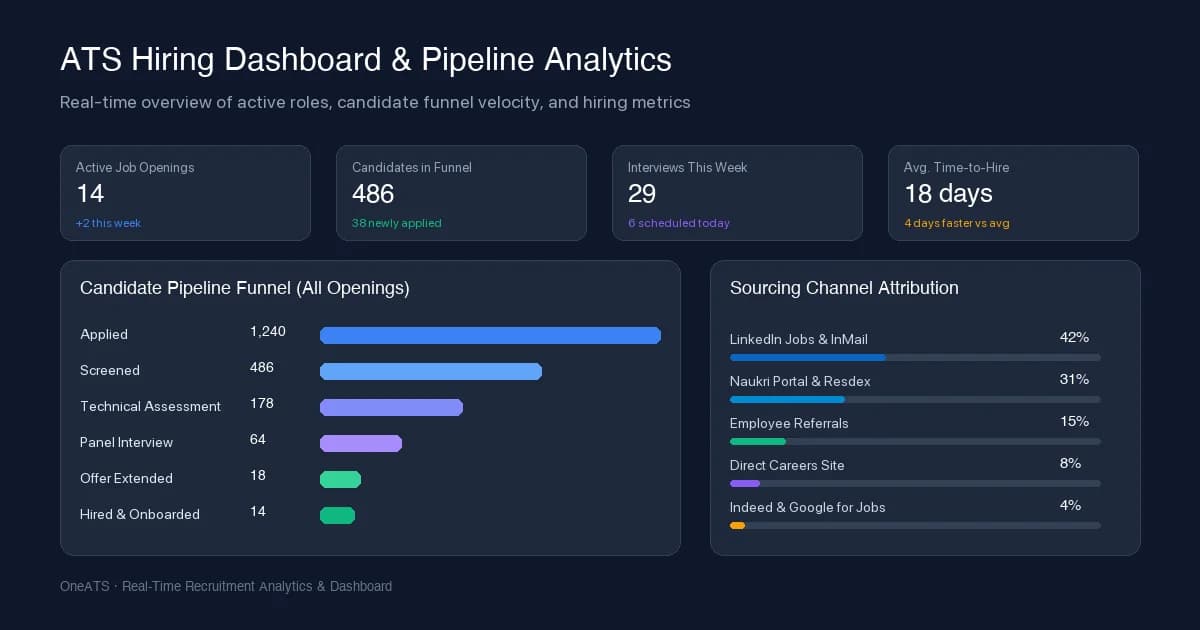
Source of hire is the percentage of your hires that came from each recruiting channel (job boards, referrals, your careers page, social media, agencies or campus). Source of hire % = hires from a source ÷ total hires × 100. Tracked accurately, it tells you where to spend your recruiting budget and where to stop.
- Track source at the applicant level automatically (tracked links), not by asking candidates "where did you hear about us?"
- Look at hires, not just applicants. Some channels send volume but few hires.
- Add quality of source: how hires from each channel perform and stay.
- Review monthly; shift budget quarterly.
How do you calculate source of hire?
``` Source of hire (%) = Hires from source ÷ Total hires × 100 ```
Example (one quarter, 24 hires)
| Source | Applicants | Hires | Source of hire % | Applicant → hire rate |
|---|---|---|---|---|
| Naukri | 1,240 | 9 | 37.5% | 0.7% |
| Careers page / Google for Jobs | 310 | 6 | 25.0% | 1.9% |
| Employee referrals | 22 | 5 | 20.8% | 22.7% |
| 180 | 2 | 8.3% | 1.1% | |
| Agency | 6 | 2 | 8.3% | 33.3% |
| Total | 1,758 | 24 | 100% | 1.4% |
Naukri delivers the most hires, but referrals convert 30× better than Naukri per applicant (22.7% vs 0.7%), so referrals deserve more investment. Illustrative data.
Why is "where did you hear about us?" unreliable?
Candidates often see a job in several places and click whichever is handy, or pick the first option in a dropdown. Self-reported source routinely misattributes hires. Use tracked apply links: each channel gets its own URL (or UTM parameters), and the ATS stamps the applicant with that source automatically.
How do you set up source tracking?
- 1Give every channel a unique tracked link: Naukri, LinkedIn, Indeed, careers page, WhatsApp share, referral links (one per employee), agency portals.
- 2Make the ATS the single entry point. Even "emailed CVs" should be forwarded into the ATS (email to ATS) and tagged "Email".
- 3Lock the original source. If a candidate applies twice, keep the first source and record the second as an "influence".
- 4Standardise source names (no "Naukri", "naukri.com" and "NAUKRI" as three sources).
- 5Report monthly on applicants, interviews, offers and hires by source.
OneATS does steps 1–4 automatically: every channel in [job distribution](/features/job-distribution) gets its own tracked link, and [source tracking](/features/source-tracking) tags each applicant.
What is quality of source?
Quality of source asks: do hires from this channel perform well and stay? Track, per source:
- 90-day retention: % of hires still employed after 90 days.
- Probation pass rate.
- Hiring-manager satisfaction at 90 days (1–5).
A channel with fewer hires but much better retention may be your best source.
What should a source of hire report include?
| Column | Why |
|---|---|
| Source | Channel name |
| Applicants | Volume |
| Screened-in % | Relevance of applicants |
| Interviews | Mid-funnel |
| Offers | Late funnel |
| Hires | Outcome |
| Source of hire % | Share of hires |
| Cost per hire by source | Efficiency → see cost per hire |
| 90-day retention | Quality |
How do you act on source-of-hire data?
- High hires, high cost (e.g., agencies) → use only for hard-to-fill roles; negotiate fees.
- High applicants, low hires (often big portals) → tighten knock-out questions and job titles.
- Low volume, high conversion (referrals, careers page) → invest: referral bonuses, careers-page content, Google for Jobs.
- Zero hires in 2 quarters → stop paying for that channel.
Frequently asked questions
What is source of hire? It's the share of total hires that came from each recruiting channel, such as job boards, referrals, careers page, social media, agencies or campus.
How is source of hire calculated? Divide hires from one source by total hires in the period and multiply by 100.
What is the best source of hire? It varies by company and role. Referrals often convert best, while job portals deliver the most volume. Measure both hires and quality to decide.
How do I track candidate sources automatically? Use tracked apply links per channel and an ATS that tags each applicant with the source of their first application.
Editorial Integrity & Sourcing: All articles are authored and verified by our recruitment operations and engineering team. Product details verified against the OneATS product in November 2026. Job-board connections work as described on each integration page.

Pankaj Mukadam is the Head of Product at OneATS. With deep expertise in talent acquisition infrastructure and recruitment operations, he leads product architecture and hiring workflows at OneATS, helping companies streamline recruitment across India and globally.