
How Does Resume Parsing Work? A Complete Guide to Resume and CV Parsing
How does resume parsing work? Learn how CV parsing extracts data from resumes, what affects accuracy, and how to choose resume parsing software for your ATS.
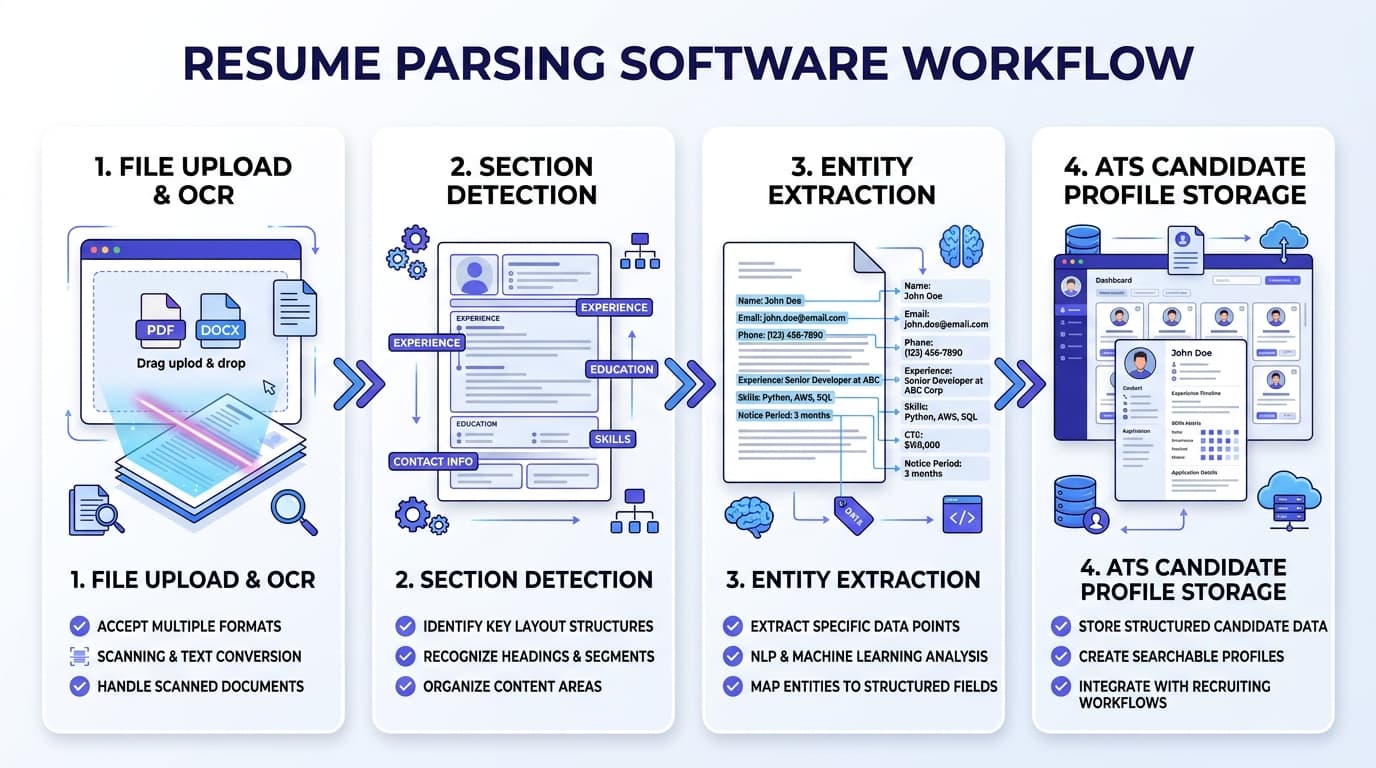
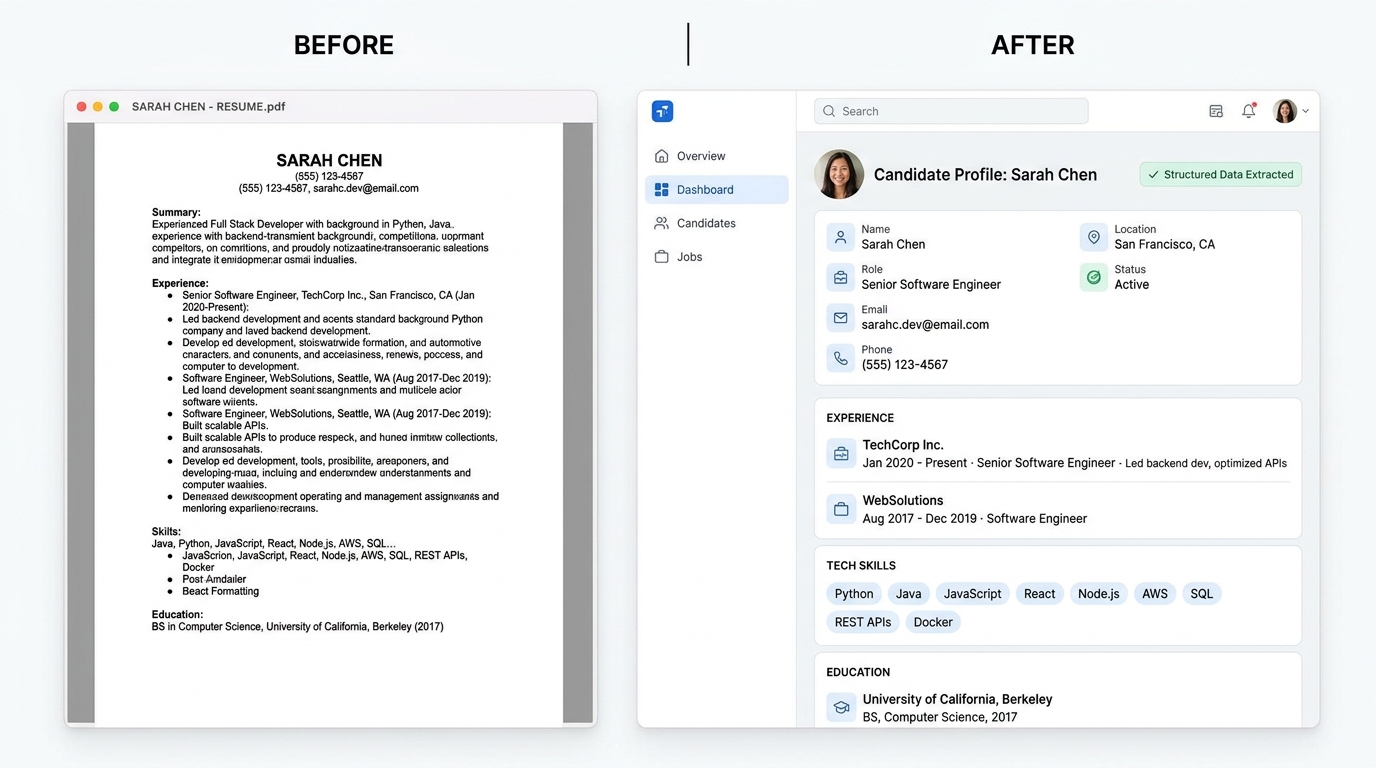
Resume parsing (also called CV parsing) is software that reads an unstructured resume file and turns it into structured data: candidate contact details, work experience, educational degrees, technical proficiencies, and job tenure. Instead of recruiters copying and pasting details into a spreadsheet or candidate database, an automated parser transforms raw documents into structured candidate profiles in seconds.
Modern resume parsing works through four sequential computational stages: it converts raw document binaries into raw text, segments the text into functional resume sections, identifies specific semantic entities (like job titles and dates) using natural language processing (NLP), and normalizes the output into standardized database records in your applicant tracking system. This comprehensive guide explains how each stage operates, what technical factors dictate parsing accuracy, and how hiring teams can choose modern resume parsing software for their recruiting workflow.
- Resume parsing automates candidate intake by converting unstructured PDF, Word, and text resumes into searchable database fields.
- The core four-step workflow consists of text extraction, section segmentation, named entity recognition (NER), and data normalization.
- Modern parsers use Natural Language Processing (NLP) and Large Language Models (LLMs) rather than brittle keyword matching rules.
- Indian hiring workflows require dedicated parsing for notice periods, current/expected CTC, and regional phone formats.
- Uploading candidate CVs to free, public online parsers poses severe data privacy risks under the DPDP Act 2023 and GDPR.
What Is Resume Parsing?
Resume parsing is the automated process of converting an unstructured resume or curriculum vitae (CV) document into a structured, machine-readable format such as JSON or database records. It programmatically extracts candidate contact info, employment history, education, skills, and certifications so recruiters can filter, search, and manage applicants instantly.
How Does Resume Parsing Work? (Step by Step)
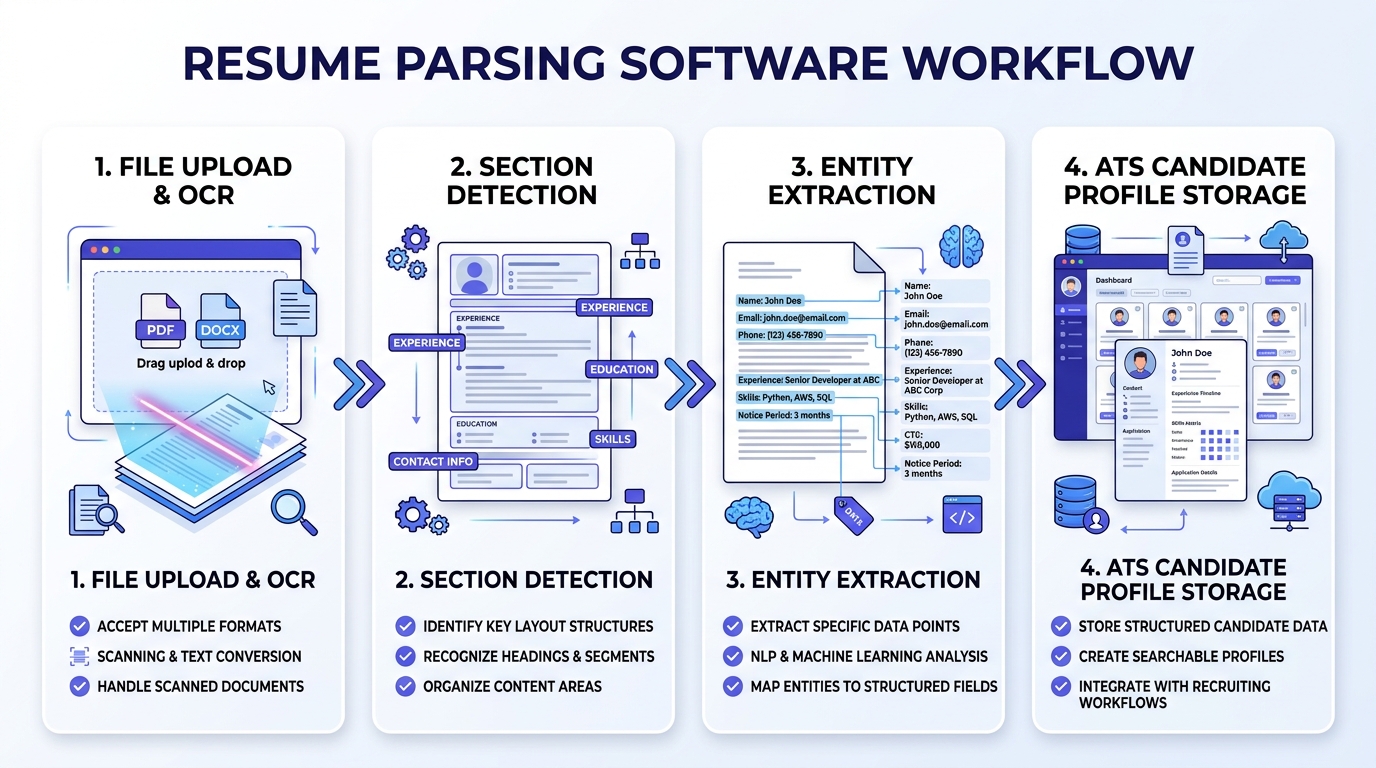
When a candidate uploads a document through an application form, forwards an email with an attachment, or when an agency performs bulk CV upload for agencies, the resume parsing engine processes the file across four continuous phases.
Step 1: File Reading and Text Extraction
The parser begins by accepting the binary file—most commonly PDF (.pdf), Microsoft Word (.docx, .doc), Rich Text Format (.rtf), or plain text (.txt). The parsing engine decrypts the document format and extracts raw string characters along with spatial metadata (font size, font weight, line coordinates, and indentation).
For native digital documents, character streams are extracted directly from the document's XML or PDF content stream. If a candidate uploads a scanned hard-copy or image-based PDF, the parser invokes an Optical Character Recognition (OCR) engine (such as Tesseract or proprietary computer vision models) to identify pixel patterns and convert scanned letterforms into selectable digital text. Complex visual elements like embedded text boxes, multi-column tables, and image headers are flattened into a linear reading order.
Step 2: Section Detection and Segmentation
Once the document is converted into plain text, the engine segments the content into logical thematic blocks. Humans recognize sections by typography, bold headings, and white space; resume parsers analyze spatial layout heuristics and vocabulary patterns.
The parser must recognize varied synonyms across different cultures and industries. For example, the employment history section may be titled 'Professional Experience', 'Work History', 'Employment Record', 'Career Summary', or 'Experience to Date'. A robust parser classifies these variations into standardized categories: Personal Information, Executive Summary, Work Experience, Education, Technical Skills, Certifications, and Additional Details.
Step 3: Named Entity Recognition (NER) & Data Extraction
Within each classified section, the parser applies Named Entity Recognition (NER) algorithms powered by machine learning to isolate individual data elements. Rather than just searching for words, NER models evaluate grammatical context and semantic relationships.
For instance, the parser distinguishes between 'Java' (the programming language) and 'Java' (the Indonesian island) by inspecting neighboring tokens like 'Spring Boot', 'microservices', and 'developed backend APIs'. It identifies dates (e.g., 'June 2021 – Present' or '08/19 to 11/23') and attaches them directly to the corresponding employer and job title, establishing a chronological employment timeline.
Step 4: Data Normalization, Duplicate Detection, and Storage
Raw extracted data is inherently messy: one candidate writes 'Senior Software Eng.', another writes 'Sr. Developer', and a third writes 'Lead Programmer'. In the final step, the parser normalizes these variations against global taxonomies:
- Skills normalization: Maps synonyms like 'JS', 'React.js', and 'ECMAScript' to standard ontology terms ('JavaScript', 'React').
- Job title taxonomy: Categorizes diverse titles into standardized seniority levels and functional job families (e.g., Software Engineering → IC3).
- Date calculations: Converts start and end dates into calculated tenure in years and months, automatically flagging career gaps.
- Duplicate detection: Matches email addresses, sanitized phone numbers, and LinkedIn URLs against your database to prevent duplicate profiles.
The clean, structured JSON payload is then stored directly in your ATS database, instantly populating the candidate's card on your hiring pipeline.
What Data Does a Resume Parser Extract?
A comprehensive ATS resume parser extracts dozens of discrete data points across personal, professional, and regional recruitment categories:
| Category | Extracted Fields | Example Extracted Value | Recruiting Function |
|---|---|---|---|
| Contact & Personal | Full Name, Email, Phone, Location, LinkedIn, Portfolio | Sarah Chen, +91 98200 12345, Mumbai, linkedin.com/in/sarah | Candidate identity verification and automated interview scheduling links |
| Work Experience | Job Title, Company Name, Start/End Dates, Total Tenure, Location | Senior Frontend Lead, Razorpay, July 2021 – Present (3 yrs 4 mos) | Relevance matching, seniority scoring, and career progression analysis |
| Skills & Stack | Hard Skills, Software Tools, Frameworks, Languages, Certifications | React, TypeScript, AWS, Next.js, Docker, Kubernetes, PMP | Automated keyword filtering and semantic talent pool searches |
| Education & Degrees | Institution, Degree Title, Major/Field of Study, Graduation Year | B.Tech in Computer Science, IIT Bombay, 2020 | Education threshold verification and graduate screening |
| Indian Market Fields | Notice Period, Current CTC, Expected CTC, Native City | 30 Days Notice, ₹24,00,000 Current, ₹32,00,000 Expected | Immediate joiner triage, offer budget alignment, and recruiter screening |
| UK / Global Fields | Right-to-work status, Visa sponsorship requirement, Languages | UK Citizen / Indefinite Leave to Remain, Fluent English, German | Statutory immigration compliance and international candidate triage |
Types of Resume Parsing Technology
Resume parsing architectures have evolved across three distinct generations over the past two decades. Understanding the differences helps hiring managers evaluate software vendor capabilities.
1. Rule-Based and Keyword Parsers (First Generation)
First-generation parsers rely on predefined dictionary matching and regular expressions (Regex). They search for explicit patterns like email regexes (`[a-z0-9]+@[a-z0-9]+\.[a-z]+`) and keyword dictionaries containing lists of universities and skill names.
While computationally fast, rule-based parsers are notoriously fragile. If a candidate uses an unexpected date format, places skills in a table, or structures headings creatively, the parser fails to associate dates with employers or skips entire sections.
2. Natural Language Processing (NLP) & ML Parsers (Second Generation)
Second-generation parsers utilize statistical machine learning models trained on millions of annotated resumes. These engines use Natural Language Processing (NLP), Part-of-Speech (POS) tagging, and conditional random fields (CRFs) to understand contextual syntax.
An NLP parser understands that in the phrase 'Managed Python backend team at Swiggy from Jan 2021', 'Swiggy' is the organization, 'Python' is a skill, 'Managed' implies leadership, and 'Jan 2021' is the inception timestamp. This generation forms the backbone of most established enterprise recruitment tools today.
3. Large Language Model (LLM) & Generative AI Parsers (Third Generation)
Modern cutting-edge parsers leverage fine-tuned Large Language Models (LLMs). Unlike older statistical parsers, LLM-based parsers have human-level linguistic comprehension. They effortlessly read multi-column layouts, understand complex project narratives, infer implicit competencies, and summarize executive career accomplishments.
Enterprise LLM parsers must include safety guardrails to prevent generative hallucinations (inventing contact details or degrees) and must comply with data isolation agreements so candidate personal data is never used to train public foundational models.
How Accurate Is Resume Parsing?
Under optimal conditions with cleanly formatted, single-column documents, modern NLP resume parsers routinely achieve 92% to 98% extraction accuracy on primary fields like names, contact numbers, email addresses, and declared skills.
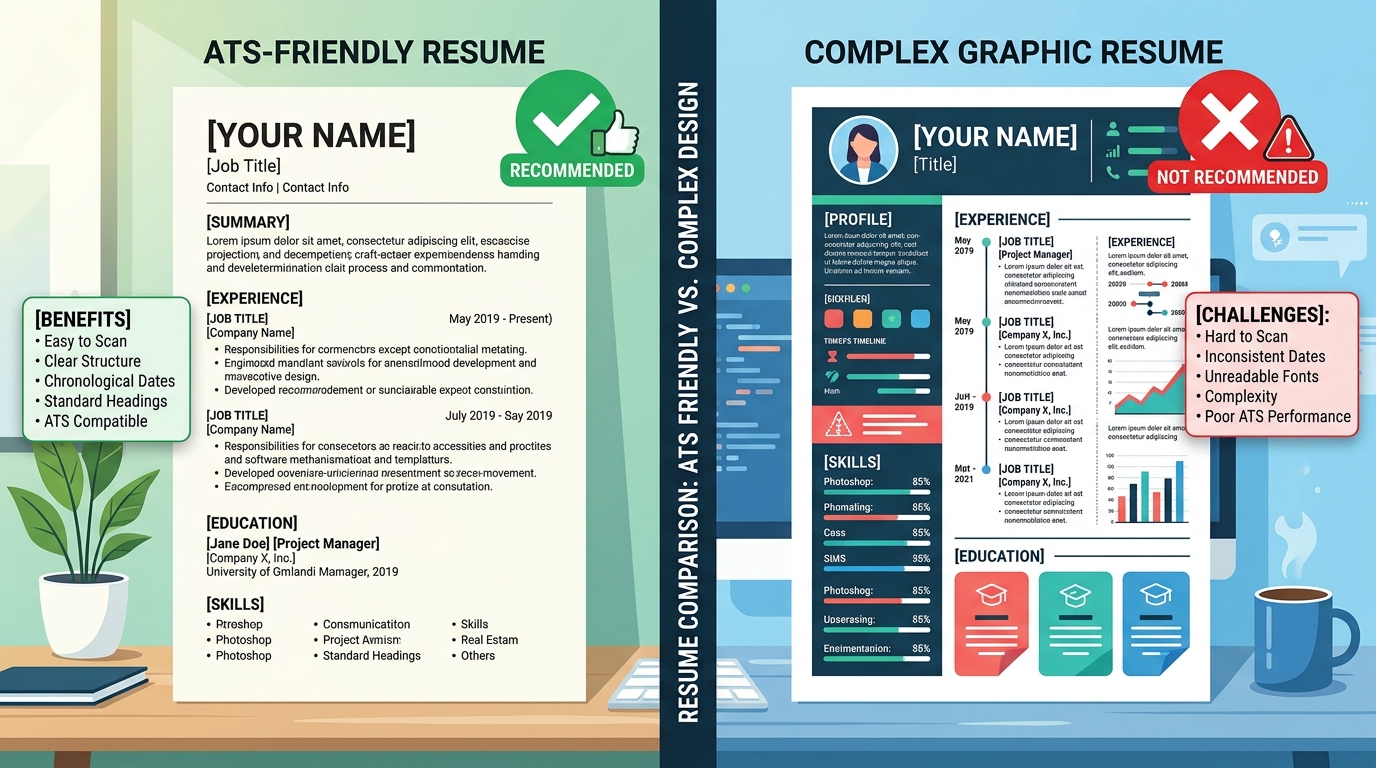
However, real-world recruitment documents exhibit substantial structural variance. Several common document elements significantly degrade parsing precision:
- Multi-column and grid layouts: When text spans two or three columns, naive parsers read horizontally across columns, conflating unrelated job titles with adjacent skills.
- Graphic elements and text boxes: Placing dates or contact details inside Microsoft Word shapes or Canva graphics often renders them invisible to text extraction streams.
- Header and footer data: Important contact numbers placed inside document header margins may be skipped by standard PDF text extractors.
- Scanned and photographed CVs: Low-resolution scans, crooked phone photographs, and skewed document scans introduce OCR typos (e.g., misreading 'rn' as 'm').
- Creative icons without text: Replacing the words 'Phone' or 'Email' with small SVG icons confuses older entity matchers that rely on lexical anchors.
How to Extract Data from a Resume: 3 Options Compared
Recruiters and hiring operations leaders generally choose between three approaches for transforming candidate CVs into candidate database records:
| Method | Speed per Resume | Direct Cost | Data Privacy & Compliance | Best Suited For |
|---|---|---|---|---|
| Manual Data Entry | 5 to 10 minutes | High internal labor cost | Controlled internal staff access | Solo founders or boutique teams hiring 1–2 roles per year |
| Free Public Online Parsers | 5 to 10 seconds (single file) | Free to use | High risk: public web tools may retain, scrape, or sell candidate data | Individual job seekers testing their own CV formatting |
| Native ATS Built-in Parser | Under 2 seconds (in bulk) | Included in platform subscription | Enterprise compliance: encrypted, DPDP Act 2023 & GDPR aligned | Growing startups, recruitment agencies, and high-volume hiring teams |
How to Choose the Best Resume Parser: 7-Point Checklist
When evaluating recruitment software and applicant tracking systems, verify that the parsing engine meets these seven operational criteria:
- 1. Real-World Document Accuracy: Test the parser with your team's actual candidate files—including messy formatting and Indian regional CVs—not pristine demo files.
- 2. Comprehensive File Format Support: Seamless processing of PDF, DOCX, DOC, RTF, TXT, and scanned image PDFs with built-in OCR.
- 3. High-Velocity Bulk Ingestion: The ability to drag-and-drop batches of 50 to 100 resumes simultaneously with background queue processing.
- 4. Inbound Email Parsing: Dedicated job-specific email forwarding addresses that automatically parse CV attachments forwarded by team members or agencies.
- 5. Automated Duplicate Management: Intelligent matching algorithms that detect existing applicants by email, mobile number, or name permutations to avoid duplicate entries.
- 6. Local Market Semantic Fields: Native recognition of Indian employment terms (Notice Period, Fixed vs. Variable CTC, Buyout Options) or European Right-to-Work credentials.
- 7. Seamless ATS Integration: Built directly into your hiring workflow so recruiters review parsed profiles, notes, and scorecards on one unified screen.
Tips for Candidates: How to Write a Resume That Parses Correctly
If you are a job seeker aiming to ensure your resume parses accurately into company applicant tracking systems, follow these five proven formatting guidelines:
- Stick to a clean, single-column hierarchy: Avoid multi-column magazine layouts, sidebars, or complex decorative grids that can confuse reading order algorithms.
- Use universal standard section headings: Label your sections with recognizable names such as 'Work Experience', 'Education', 'Technical Skills', and 'Certifications'.
- Keep contact information in the body: Place your name, phone number, email, and location at the top of the main page body rather than buried inside document header or footer margins.
- Maintain consistent chronological date formats: Write employment dates consistently (e.g., 'MM/YYYY – MM/YYYY' or 'Month YYYY – Month YYYY') alongside job titles and company names.
- Submit standard PDF or DOCX formats: Avoid saving your CV as an image file (PNG, JPG) or embedding crucial text inside non-selectable graphic blocks.
Modern Resume Parsing in OneATS
OneATS includes enterprise-grade, NLP-powered resume parsing software on every tier. Designed specifically for modern hiring teams, fast-growing startups, and staffing agencies, OneATS handles candidate intake at scale:
- Batch resume upload: Drag and drop dozens of candidate resumes in one click and watch structured candidate profiles populate in real time.
- Inbound email forwarding: Forward candidate resumes from your personal inbox or staffing vendors directly to a role-specific email address.
- Side-by-side verification: View the original uploaded PDF alongside the parsed profile on a single split screen for instantaneous verification.
- Indian market specialization: Automatically captures notice periods, current compensation, and expected CTC from standard Indian resume formats.
- Seamless candidate pipeline: Connect parsed candidates directly to interview scheduling, panel scorecards, and multi-channel posting when you post jobs on Naukri, LinkedIn and Indeed at once.
Stop wasting hours on manual resume data entry. Start your 14-day free trial on OneATS today—no credit card required.
- Unlimited resume parsing on paid plans
- Instant multi-channel job distribution
- Full DPDP Act 2023 compliance
What is resume parsing?▼
How does resume parsing work?▼
Is CV parsing the same as resume parsing?▼
Can a resume parser read scanned PDFs?▼
Are free online resume parsers safe to use for candidate CVs?▼
Does an ATS reject resumes that do not parse perfectly?▼

Pankaj Mukadam is the Head of Product at OneATS. With deep expertise in talent acquisition infrastructure and recruitment operations, he leads product architecture and hiring workflows at OneATS, helping companies streamline recruitment across India and globally.
Try OneATS free
See how OneATS handles this. Start a free trial to post jobs across major boards, organize candidate pipelines, automate interview scheduling, and onboard new hires—all in one place.
Start free trialKeep reading
23 October 2026 · 7 min read
18 October 2026 · 11 min read
14 October 2026 · 2 min read