
ATS vs Recruitment CRM: Why Staffing Agencies Need an ATS and CRM in One
ATS vs recruitment CRM: what each does, why staffing agencies need both, and how an ATS and CRM in one system manages clients, candidates and placements.
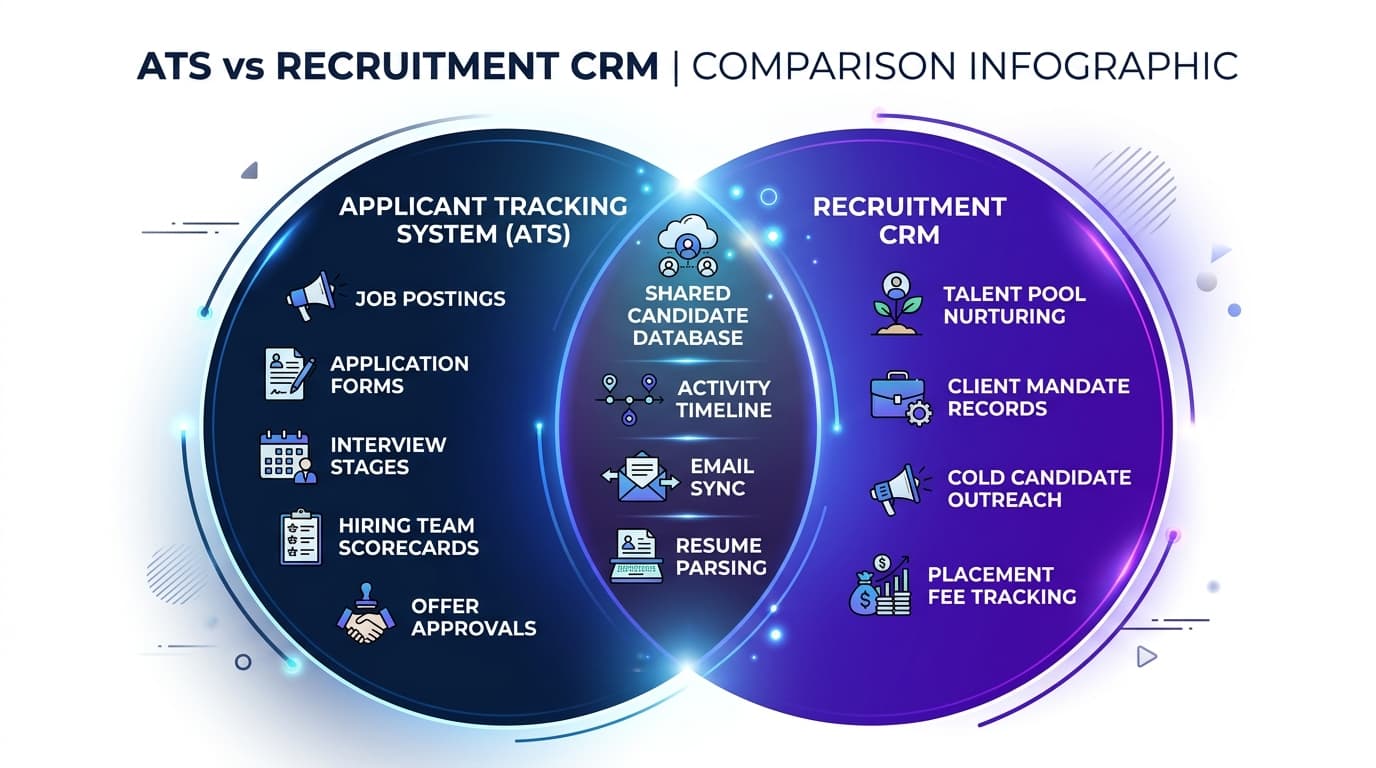
An applicant tracking system (ATS) manages candidates who apply for a specific open job requisition. A recruitment CRM (Candidate Relationship Management system) manages ongoing relationships with candidates and clients over time, including passive talent who have not applied for anything yet. While in-house corporate HR teams can often operate effectively with an ATS alone, staffing and recruitment agencies fundamentally require both capabilities to run a profitable recruitment business.
Why do agencies need both? Because staffing agencies do not simply process applicants—they cultivate proprietary candidate networks, manage multi-client mandates, pitch candidate shortlists, and protect placement fees across months and years. This comprehensive guide details the key differences between an ATS and recruitment CRM, the operational hazards of running them as disconnected tools, and why modern search firms are shifting toward an ATS for recruitment agencies that delivers both systems in one unified platform.
- An ATS manages active job applicants through sequential hiring stages; a recruitment CRM builds and nurtures long-term talent pools and client relationships.
- Corporate HR teams focus on immediate open requisitions; staffing agencies re-monetize the same candidate profiles across multiple client mandates.
- Operating an ATS and CRM as separate software subscriptions results in duplicate candidate records, lost placement attribution, and redundant data entry.
- A unified system provides end-to-end recruitment operations: searchable talent pools, client mandate management, timestamped candidate ownership, and automated GST billing.
- Consolidating into an all-in-one platform cuts software licensing costs and accelerates consultant submittal velocity.
What Is an Applicant Tracking System (ATS)?
An applicant tracking system is recruitment software built to manage the logistical workflow of filling specific, active job openings. An ATS automates job board distribution, processes inbound job applications, parses uploaded resumes, facilitates interview scheduling, collects panel scorecards, and manages offer generation.
The ATS workflow begins when a job requisition is opened and terminates when the successful candidate joins or the vacancy is closed. For corporate internal recruitment teams, an ATS is the central system of record for operational compliance, hiring manager collaboration, and candidate throughput.
What Is a Recruitment CRM?
A recruitment CRM (Candidate Relationship Management system) is software designed to build, nurture, and engage talent communities and client relationships long before a specific job opening is posted. It acts as an active database for silver-medalist applicants, passive candidates sourced on LinkedIn or GitHub, and past placements who may be ready for their next career transition.
For staffing agencies, a recruitment CRM also encompasses client account management: tracking prospective client contacts, agreed placement fee terms (e.g., 8.33% or 15% of annual CTC), candidate submittal histories, client feedback loops, and billing milestones.
ATS vs Recruitment CRM: Key Differences Compared
While both systems store candidate CVs, their strategic goals, user workflows, and success metrics differ across every dimension:
| Dimension | Applicant Tracking System (ATS) | Recruitment CRM | Unified ATS + CRM Platform |
|---|---|---|---|
| Primary Focus | Active applicants applying for specific, open vacancies | Long-term candidate networks, passive talent pools, and client mandates | Seamless end-to-end management from passive sourcing to active placement |
| Workflow Inception | Starts when an applicant applies to an active job opening | Starts months before a job exists, through sourcing or relationship outreach | Continuous: sourced profiles flow directly into active client mandates |
| Core Feature Set | Job distribution, resume parsing, pipeline stages, interview scorecards, offers | Talent pools, tagging, email outreach, client contacts, submittal history | Multi-channel distribution + talent pool + client mandates + fee billing |
| Primary User Base | In-house HR teams, hiring managers, and enterprise recruiters | Staffing agency consultants, executive headhunters, and sourcers | Full recruitment teams, agency account managers, and business developers |
| Success Metrics | Time-to-hire, cost-per-hire, offer acceptance rate, pipeline conversion | Placements made, candidate re-engagement rate, client billings, consultant revenue | Total revenue generated, time-to-submittal, and candidate retention rate |
| Data Freshness | Candidate data often becomes stale once the requisition closes | Profiles are continuously updated with notes, CTC shifts, and contact updates | Dynamic profiles automatically refreshed with each interaction and touchpoint |
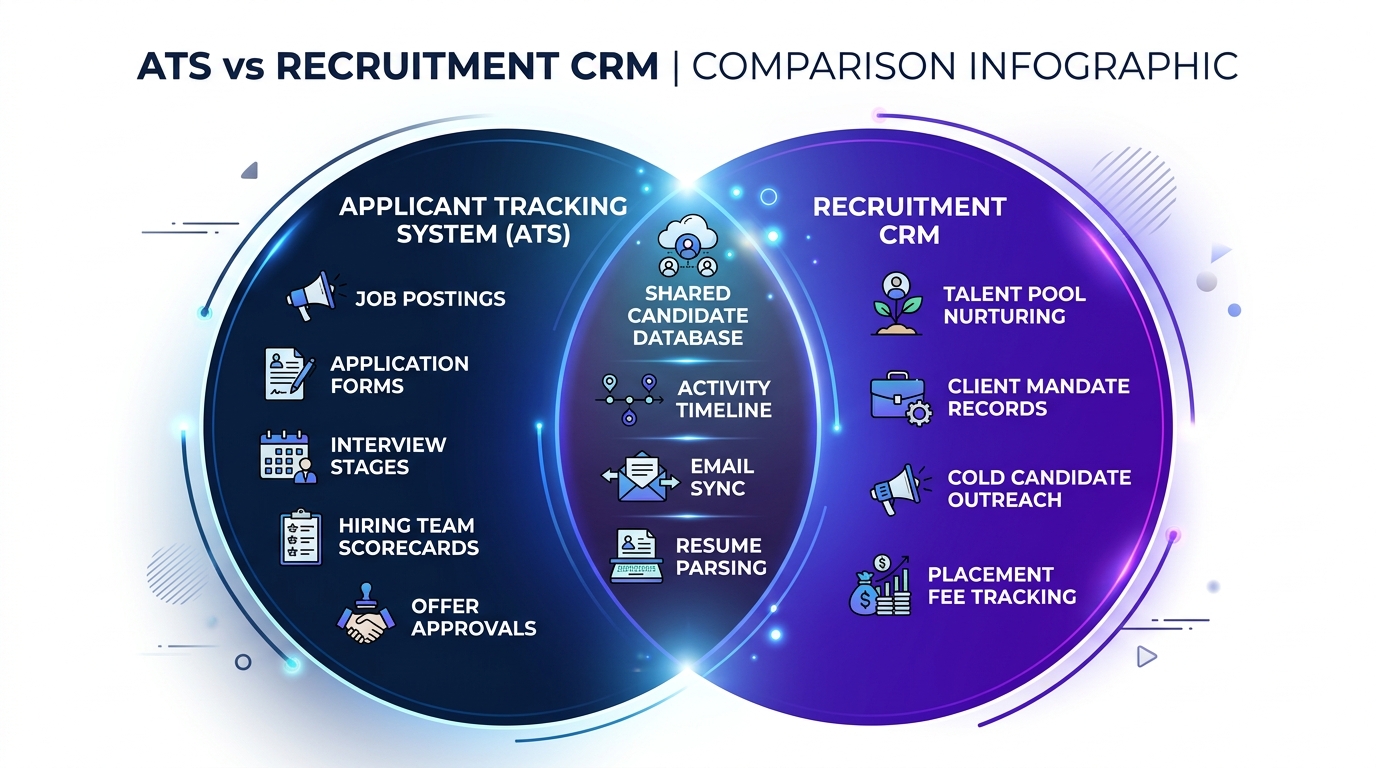
Why Staffing Agencies Need Both Systems
In-house talent acquisition teams hire for one employer. When they reject a talented candidate for an engineering role, that candidate often sits idle in their database. Staffing agencies operate on a fundamentally different economic model:
- Candidates are resubmitted across multiple client mandates: An agency that screens a Senior DevOps Engineer in Mumbai does not want to discard that profile after one client interview. They want to submit that candidate to five different tech enterprise mandates.
- Client relationship pipelines dictate agency revenue: Agency consultants must track which hiring managers have signed terms, what commission percentage was agreed (e.g., 8.33% with a 90-day replacement clause), and what fee is receivable.
- Candidate ownership disputes must be prevented: In high-volume agency environments, two consultants often connect with the same candidate on LinkedIn. Without clear timestamped ownership locking, fee splits cause bitter internal disputes.
- Client review must be frictionless: Agencies need to share candidate shortlists with external client hiring managers through secure portals without forcing clients to purchase expensive software user seats.
The Problem with Running an ATS and CRM Separately
Historically, staffing agencies purchased two separate tools: an ATS (such as Greenhouse or Lever) to manage active job applicants, and a dedicated CRM (such as Bullhorn, Salesforce, or Loxo) to store their candidate pool. In practice, this dual-stack approach creates critical operational bottlenecks:
- Duplicate candidate records and synchronization errors: Candidates update their contact details or CTC in one tool while the other reflects outdated information, leading to embarrassing candidate outreach errors.
- Double software subscription overhead: Paying separate monthly per-user licensing fees for two complex platforms doubles software expenditure for scaling agencies.
- Consultant context switching: Recruiters spend half their workday exporting spreadsheets from the CRM and manually importing them into the ATS, dragging down submittal velocity.
- Fragmented activity history: When an agency consultant speaks with a candidate, interview notes and feedback remain trapped in the ATS and never sync to the long-term CRM profile.
- Blind spots in placement fee revenue: Because client contract terms live in the CRM while actual interview progress lives in the ATS, agency owners lack a single real-time forecast of placement revenue.
What an ATS and CRM in One Looks Like
A unified platform combines the structured interview pipeline of an applicant tracking system with the client and relationship management power of a recruitment CRM. Here are the core pillars of an integrated solution:
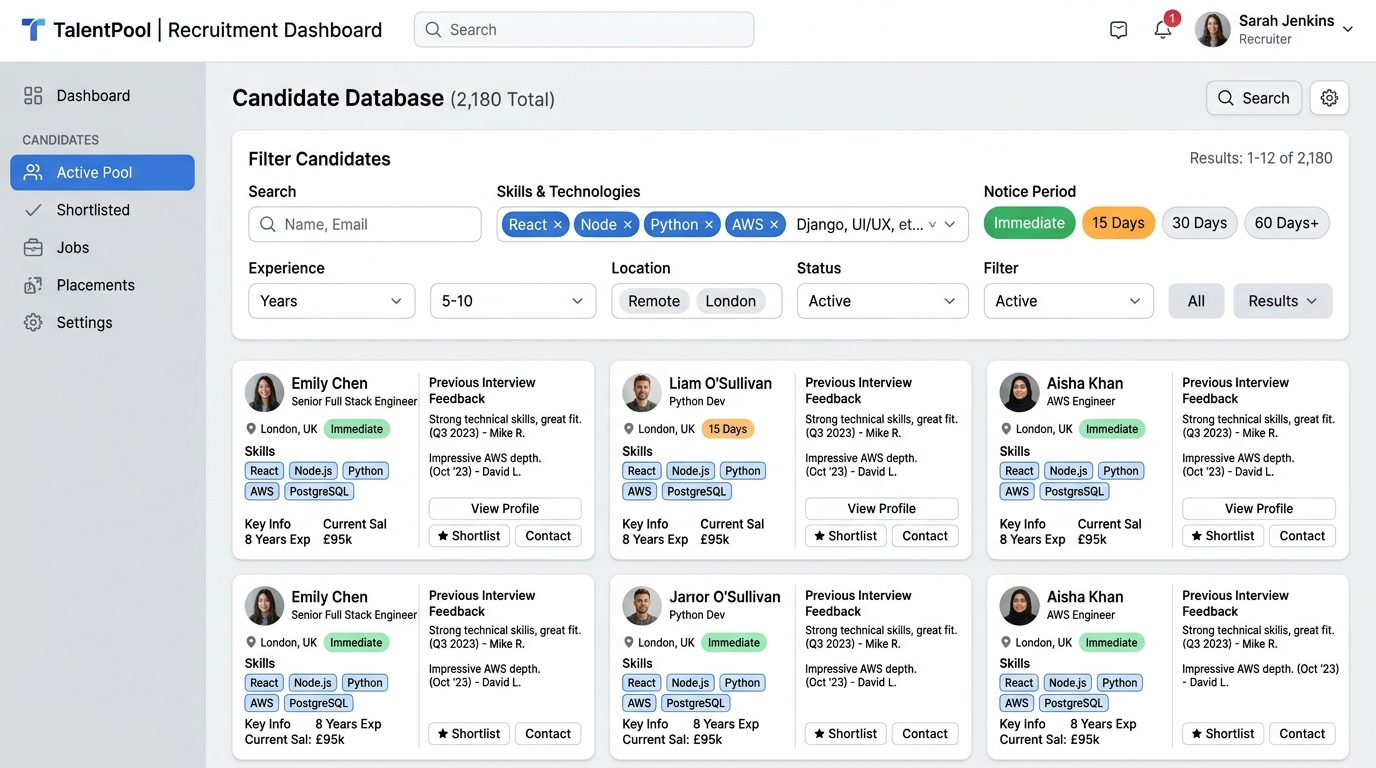
1. One Central Candidate Database and Talent Pool
Every resume ingested—whether from website applications, bulk CV parsing, or inbound vendor emails—is stored in a single, searchable talent pool. Consultants execute multi-parameter Boolean and faceted searches across technical skills, geographical locations, notice periods, and CTC ranges in seconds.
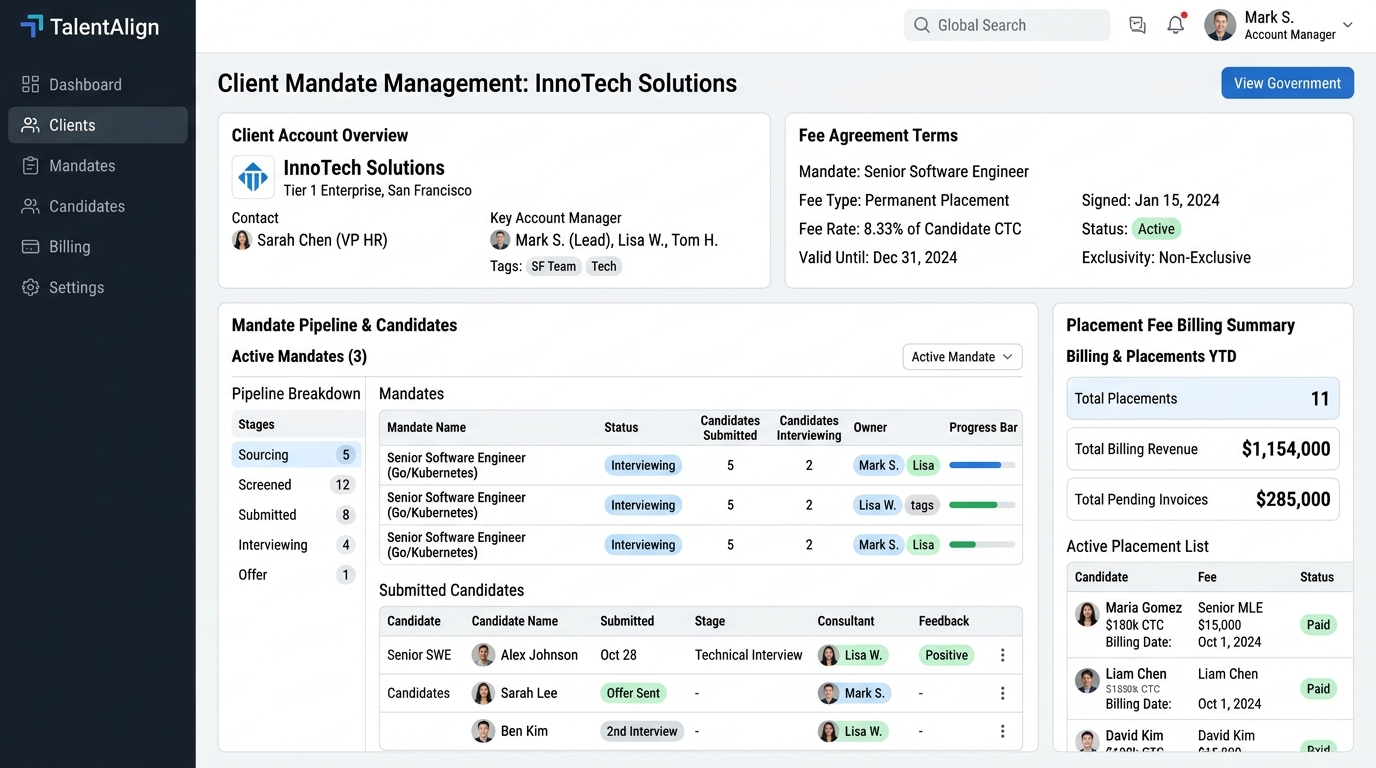
2. Client Accounts and Mandate Records with Fee Terms
Staffing agencies manage client company profiles alongside hiring requisitions. Each client record documents primary hiring manager contacts, agreed placement percentage terms (e.g., 8.33% or 12.5% of annual CTC), guarantee replacement timelines (30, 60, or 90 days), and historical submittals.
3. Timestamped Candidate Ownership & Duplicate Protection
When a consultant submits a candidate to a client mandate, the platform establishes a verifiable, timestamped ownership lock linked to the candidate's verified email and phone number. If another consultant or vendor attempts to submit the same profile, the platform flags the existing lock, protecting consultant commissions.
4. Secure Client Review Portals Without Seat Fees
Instead of emailing messy Word documents with personal contact numbers, consultants send secure client review links. Client hiring managers review agency-branded candidate profiles, leave structured feedback, and trigger interview scheduling without needing paid login seats.
5. Automated Placement Fee Invoicing and GST Compliance
When a submitted candidate accepts an offer and joins, the system automatically computes placement commissions from the signed contract terms, generates a compliant GST tax invoice (with SAC 998512 codes for Indian recruitment), and tracks receivable collections.
6. Instant Re-Engagement of Past Candidates
When a new client mandate opens, consultants do not need to start sourcing from scratch. They search existing talent pools for candidates who interviewed well previously, matching source tracking metrics with current hiring requirements.
How to Choose an ATS with CRM for Your Agency: 8-Point Checklist
When evaluating combined recruitment software for your staffing firm, ensure the vendor satisfies these eight operational capabilities:
- 1. True Multi-Client Mandate Management: Dedicated pipelines per client mandate with configurable confidentiality settings.
- 2. Comprehensive Talent Pool Search: Deep boolean search by exact skills, Indian notice periods, current/expected CTC, and location.
- 3. Automated Candidate Ownership Locking: Verifiable timestamping to eliminate commission disputes between consultants.
- 4. Client Collaboration Portals: Expiring, secure review links that let external hiring managers review profiles with zero seat fees.
- 5. Direct Job Board Integrations: Instant posting to Naukri, LinkedIn, and Indeed using agency employer subscriptions.
- 6. High-Speed Bulk Resume Parsing: Ingesting 50+ resumes at once; see our guide on how resume parsing works.
- 7. Placement Fee Billing & Tax Invoicing: Automated calculation of placement fees and compliant GST tax invoice generation.
- 8. Scalable Agency Pricing: Predictable, transparent pricing tailored for agency desks without punitive per-candidate penalties.
When Does a Standalone CRM Still Make Sense?
While 90% of recruitment firms benefit from an integrated ATS and CRM, standalone enterprise CRMs (like Salesforce with complex custom integrations) may still make sense for very large international staffing conglomerates that employ dedicated marketing teams running multi-stage automated cold email drip sequences across tens of thousands of corporate leads.
However, for modern search firms, permanent recruitment agencies, and IT staffing companies with 5 to 100 recruiters, the overhead of maintaining two separate tools drastically outweighs the marginal benefits of specialized marketing automation.
How OneATS Delivers ATS and CRM in One Platform
OneATS was purpose-built to eliminate the divide between candidate tracking and relationship management. Designed specifically for Indian and global recruitment agencies, OneATS combines:
- Dedicated agency account workspaces with separate client and mandate pipelines.
- Timestamped candidate ownership locking to protect consultant placement fees.
- Zero-login client review links with open-tracking and instant interview scheduling.
- Direct Naukri integration that consumes your own employer posting credits.
- Automated placement fee calculation and GST tax invoice generation.
Explore our dedicated staffing agency ATS to see how modern recruitment firms manage mandates, candidates, and client invoicing from one centralized system.
Stop paying for separate ATS and CRM subscriptions. Manage your clients, candidates, and placement fees on a single unified platform.
- Includes 50 active jobs & 10 recruiter seats on Business
- Unlimited candidate talent pool and bulk CV parsing
- 14-day free trial with no credit card required
What is the difference between an ATS and a CRM in recruitment?▼
Do recruitment agencies need a CRM?▼
Can one software system serve as both an ATS and a recruitment CRM?▼
What is candidate tracking software?▼
What is a talent pool in recruitment?▼
How much does an ATS with built-in CRM cost for a staffing agency?▼

Pankaj Mukadam is the Head of Product at OneATS. With deep expertise in talent acquisition infrastructure and recruitment operations, he leads product architecture and hiring workflows at OneATS, helping companies streamline recruitment across India and globally.
Try OneATS free
See how OneATS handles this. Start a free trial to post jobs across major boards, organize candidate pipelines, automate interview scheduling, and onboard new hires—all in one place.
Start free trialKeep reading
27 October 2026 · 9 min read
18 October 2026 · 11 min read
14 October 2026 · 2 min read